
What is RUL (Remaining Useful Life)? From Equipment Degradation Prediction to Predictive Maintenance Decisions
How long can the equipment continue to operate stably after an abnormality occurs?
For on-site maintenance supervisors, reliability engineers, and facilities teams, this question is often more important than “Is the equipment currently experiencing any abnormalities?”
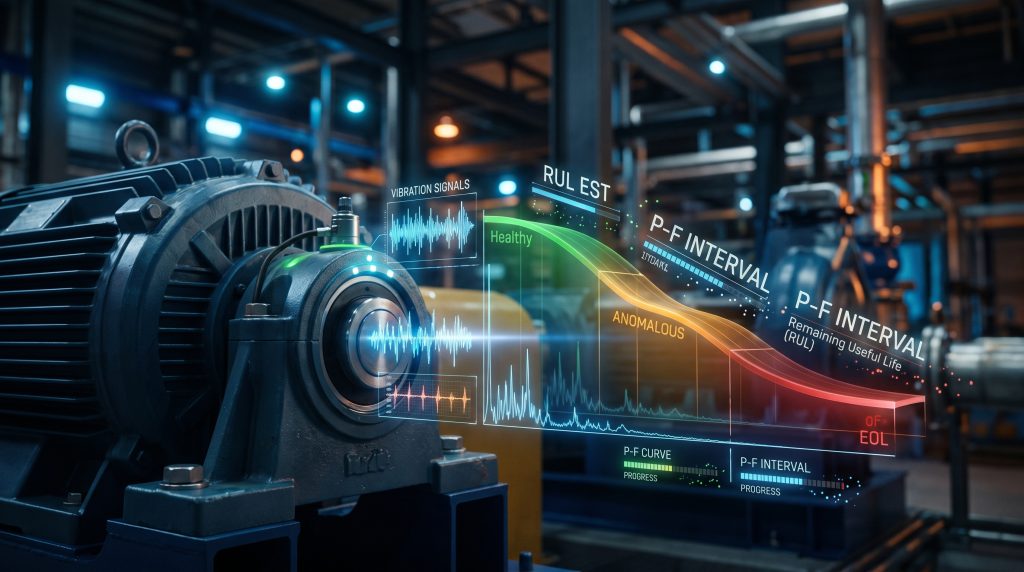
When the monitoring system detects that equipment is beginning to deteriorate, what truly needs to be addressed is not simply “repair or not repair,” but:
Would it be too early to fix it now?
Keep running, will it be too late?
If maintenance is performed too early, it may waste the remaining useful life of components and increase unnecessary downtime and maintenance costs; if it is handled too late, it may develop into Unplanned Downtime, cause collateral damage, and even affect production, safety, and delivery schedules.
RUL(Remaining Useful Life)is precisely an important technical indicator used to support this type of maintenance decision.
It estimates how much usable time remains between the “current point in time” and the predefined failure threshold (End-of-Life, EOL), based on the equipment’s current health status, historical data, degradation trends, and operating conditions.
But we first need to establish a correct understanding:
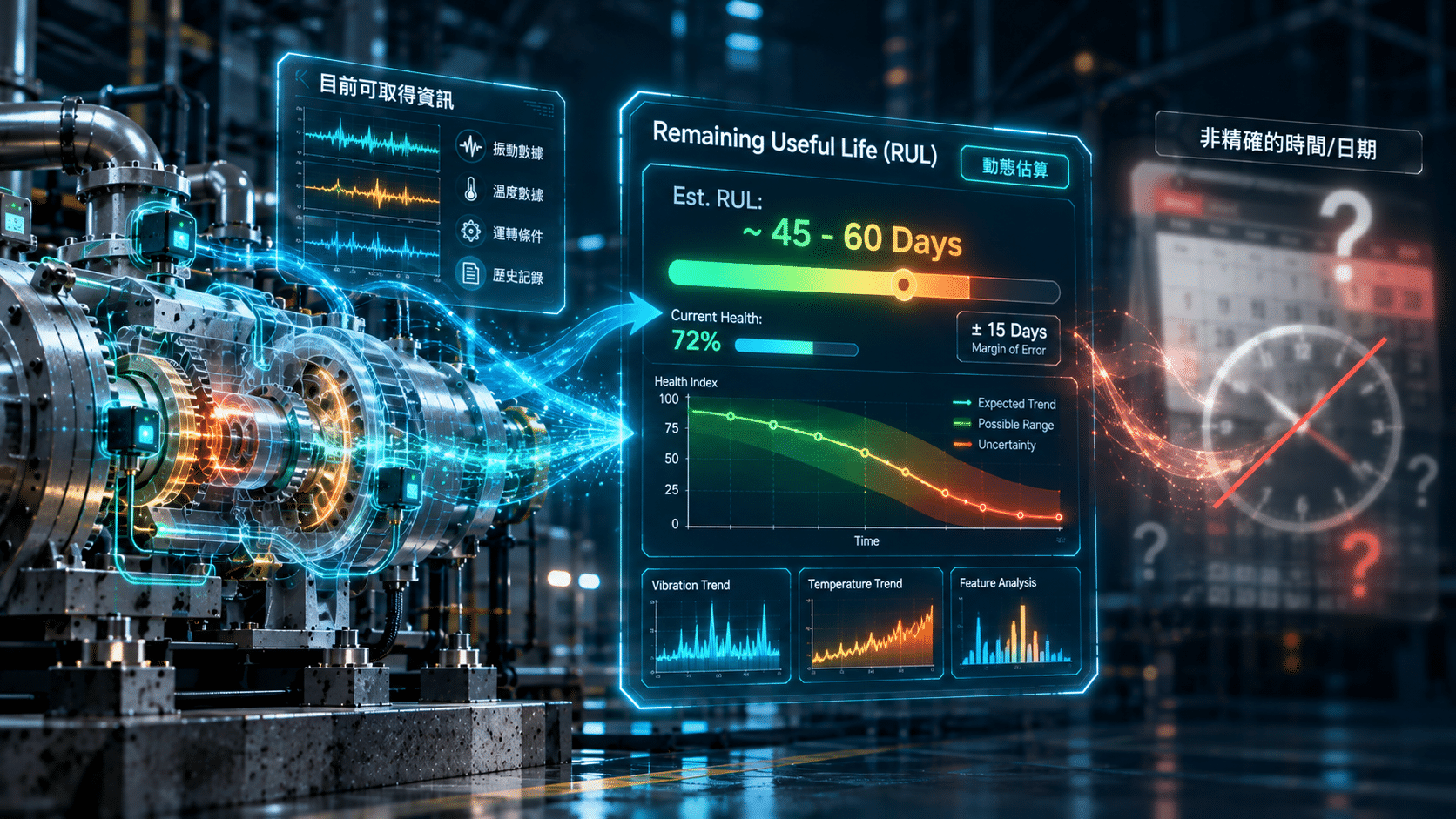
RUL is not an exact prediction of the specific day or time when a device will definitely fail, but rather a dynamic estimate of the device’s remaining useful life based on the information currently available.
Therefore, the true value of RUL is not to “calculate a date,” but to provide the maintenance team with sufficient early warning and a basis for decision-making, allowing spare parts, maintenance manpower, and downtime scheduling to be planned in advance.
What is RUL? Understanding Equipment Degradation Through the P-F Curve
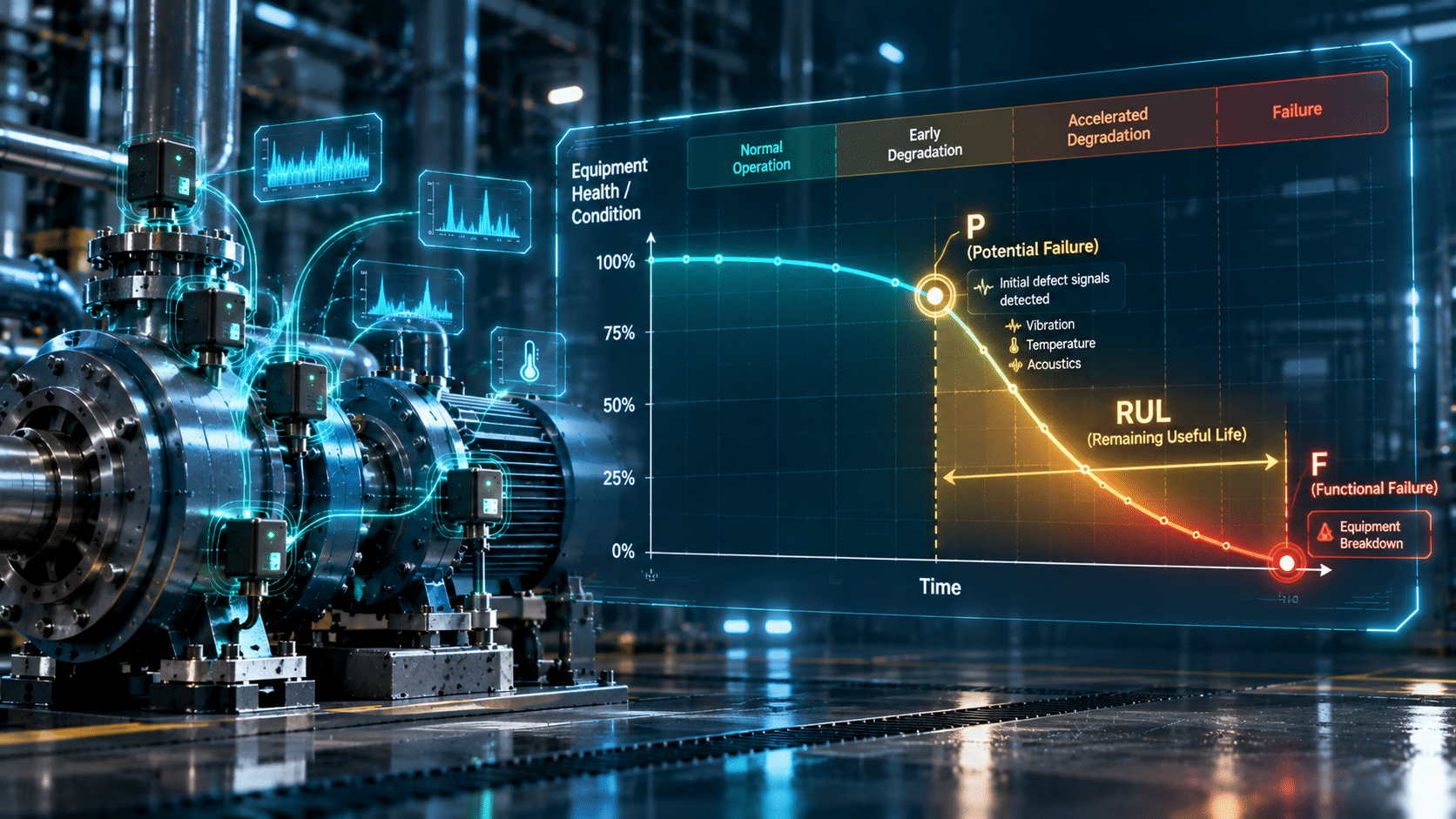
RUL (Remaining Useful Life) refers to the estimated remaining usable time from the current observation point until the equipment or critical component reaches a predefined failure condition (EOL) or maintenance threshold. Taking pump bearings as an example, long-term vibration monitoring can be used to observe changes in the equipment from healthy operation, to signs of abnormalities, and then to continuous degradation, thereby assessing its future remaining useful life.
In reliability engineering, the P-F Curve can be used to understand the equipment degradation process: the P point (Potential Failure) indicates that a detectable potential failure has occurred, while the F point (Functional Failure) indicates that the equipment can no longer maintain its expected function. The time between the two is called the P-F Interval.
RUL and P-F Interval are not exactly the same. The P-F Interval describes the time window from “detectable degradation to functional failure”; RUL, on the other hand, estimates how much time remains from “now” until a predefined EOL. Therefore, the key to RUL prediction is to first clearly define what state represents the point at which the equipment needs maintenance or must be taken out of operation.
The premise of RUL: first define what constitutes the end of life
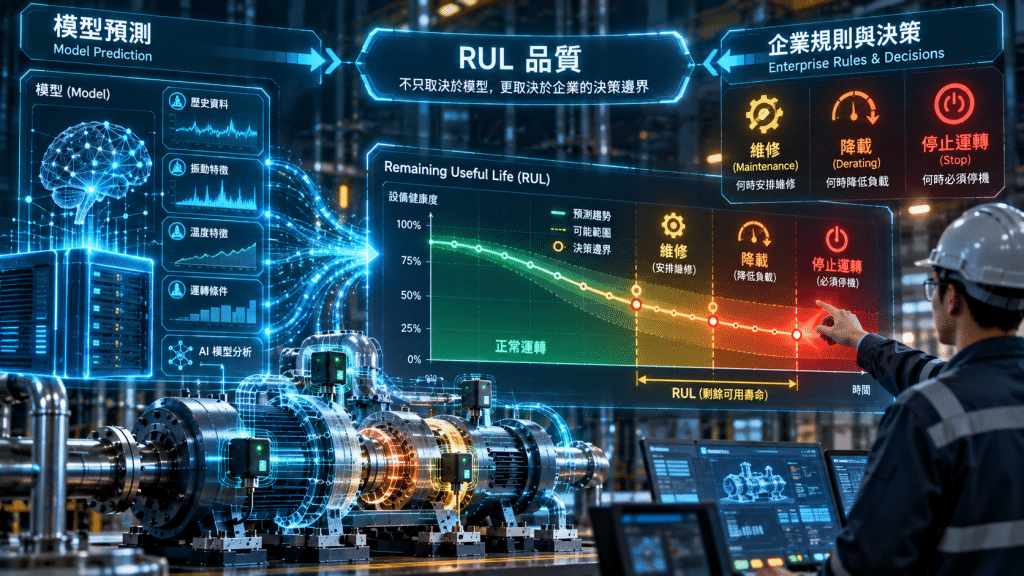
RUL prediction may seem to be answering the question “How much longer can the equipment keep operating,” but the real first question is: What state counts as the end of life (EOL)? For industrial equipment, EOL does not necessarily mean a complete shutdown; it may also mean that vibration values continuously exceed the maintenance threshold, failure characteristics continue to deteriorate, pump flow rate or efficiency can no longer meet process requirements, or the risk of continued operation has exceeded the level acceptable to the enterprise.
Therefore, the significance of RUL lies not only in predicting the remaining time, but also in determining “when action needs to be taken”.
The quality of RUL depends not only on the model, but also on whether the enterprise can clearly define when equipment must be repaired, derated, or shut down.
From Condition Monitoring to RUL: What Problems Does Each Aspect of PHM Solve?
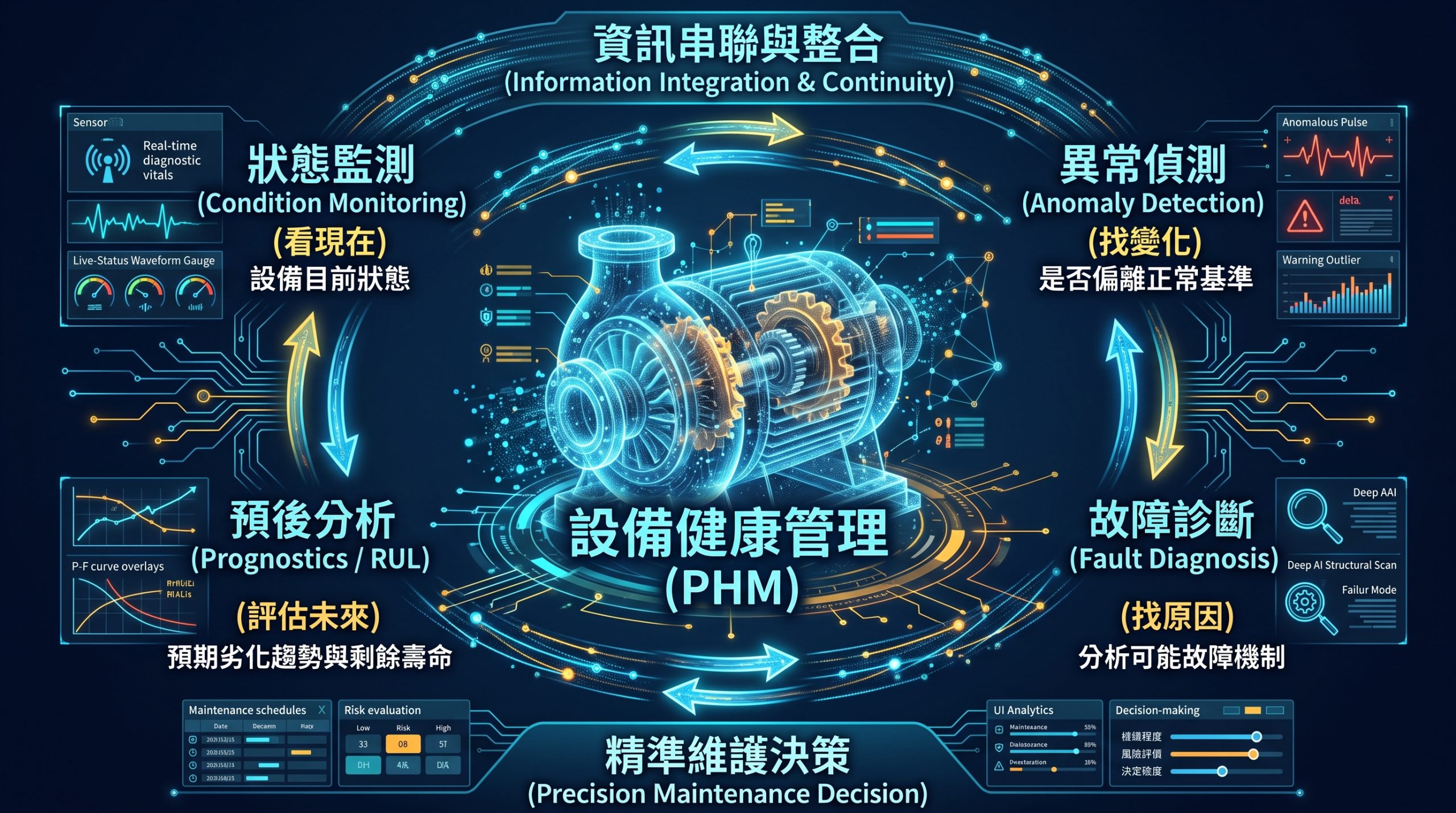
In Prognostics and Health Management (PHM), different analytical capabilities answer different questions: condition monitoring determines the equipment’s current condition; anomaly detection determines whether it has deviated from the normal baseline; fault diagnosis analyzes which fault mechanisms may be responsible for the anomaly; prognostics (Prognostics / RUL) evaluates degradation trends and future remaining useful life.
It can be simply understood as: look at the present → identify changes → find the reasons → assess the future.
These capabilities are not linear processes that must be executed in sequence, but rather mutually supportive analytical capabilities within PHM. The real value lies in connecting the information, from the equipment’s current condition, degree of degradation, and possible causes to future risks and maintenance timing, helping enterprises make more informed maintenance decisions.
Why is vibration important data for the RUL of rotating equipment?
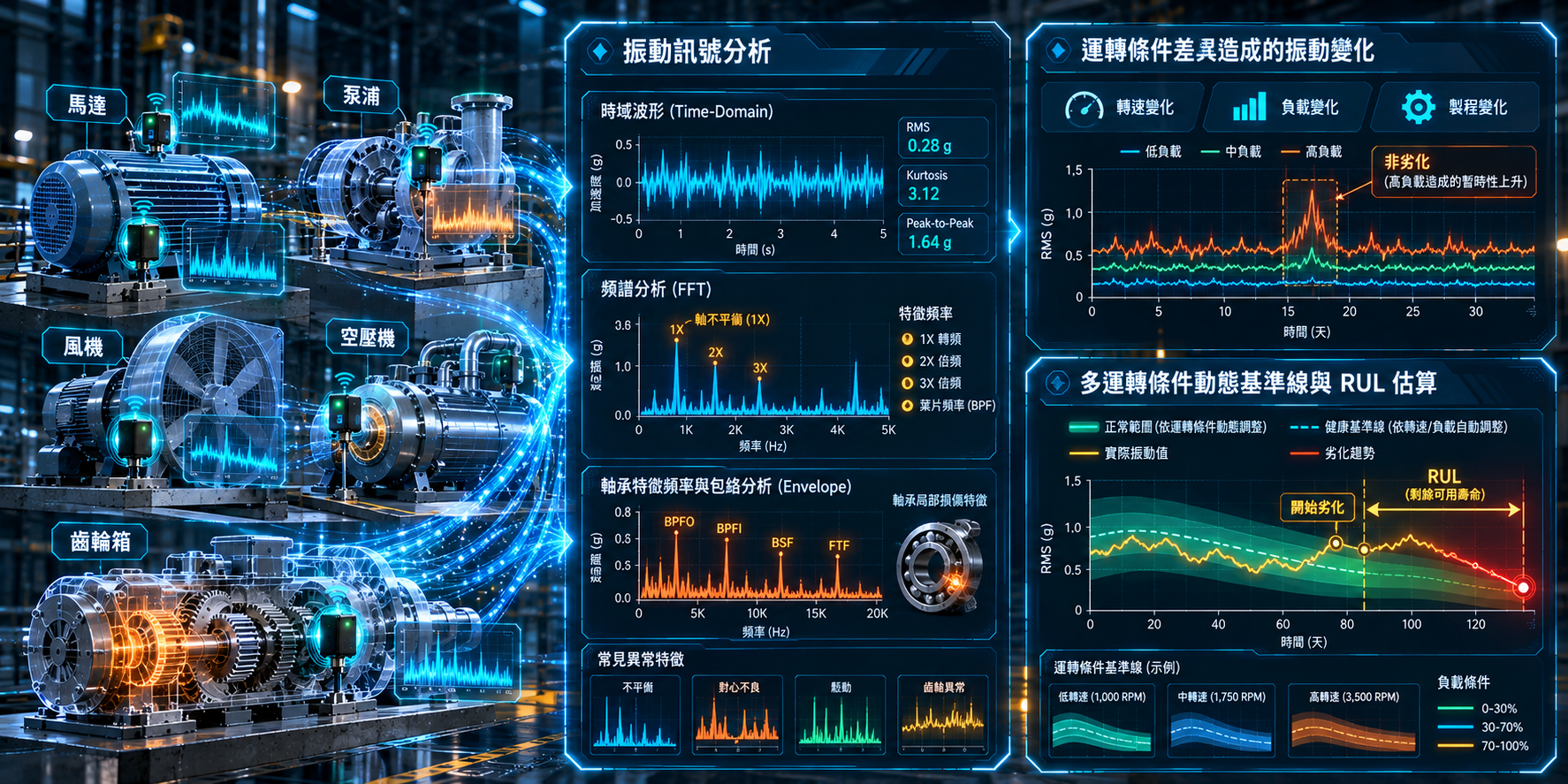
For rotating equipment such as motors, pumps, fans, compressors, and gearboxes, vibration is an important indicator of mechanical health. Bearing damage, imbalance, misalignment, mechanical looseness, gear damage, and lubrication abnormalities can all leave characteristic signatures in vibration signals.
Through time-domain, frequency-domain, and signal analysis, information such as RMS, Peak, Kurtosis, spectral features, bearing characteristic frequencies, and envelope analysis can be extracted as a basis for health assessment and degradation tracking.
However, an increase in vibration does not necessarily mean that the equipment is rapidly approaching failure, because rotational speed, load, process conditions, and installation conditions can all affect vibration. Therefore, the key to RUL is not simply setting an anomaly threshold, but establishing normal baselines under different operating conditions, so that equipment degradation can be assessed more reliably.
The Three Major Challenges of Implementing RUL in Industrial Settings
Challenge 1: Run-to-Failure Data Is Extremely Scarce
An ideal RUL model would ideally have seen the complete trajectories of a large number of pieces of equipment, from healthy operation all the way to failure.
But actual factories usually aren't like this.
When the equipment shows obvious abnormalities, maintenance personnel usually replace the parts in advance rather than deliberately letting the equipment continue operating until it completely fails.
Therefore, enterprises typically have:
A large amount of normal data
But relatively lacking:
Complete failure history data.
This is also why industrial RUL cannot simply apply consumer AI data science methods.
Model design must take into account the data limitations arising from actual maintenance processes.
Challenge 2: Health indicators cannot be directly compared under different operating conditions
The same equipment under different:
- Rotational speed
- Load
- process
- Environment
The vibration characteristics may be completely different.
Therefore, Operating Conditions must be addressed first to establish a reasonable equipment health baseline, so that we can determine:
Is this a normal operating condition change?
or:
Is the equipment really deteriorating?
This is also an important prerequisite for establishing a reliable Health Index.
Challenge 3: RUL must be actionable for actual maintenance actions
If the system tells the engineer:
「RUL = 30 days」
The next question will definitely be:
So when should I fix it?
Therefore, a truly valuable RUL should not simply output a single number, but should enable the maintenance team to understand:
- Is the deterioration trend continuing?
- What range is the estimated remaining time approximately?
- How uncertain is the prediction?
- How important is the equipment?
- When is the next scheduled shutdown?
- Is the lead time for the supplies sufficient?
- Is it necessary to conduct a manual recheck in advance?
RUL only truly creates business value when the prediction results can be integrated into the maintenance process.
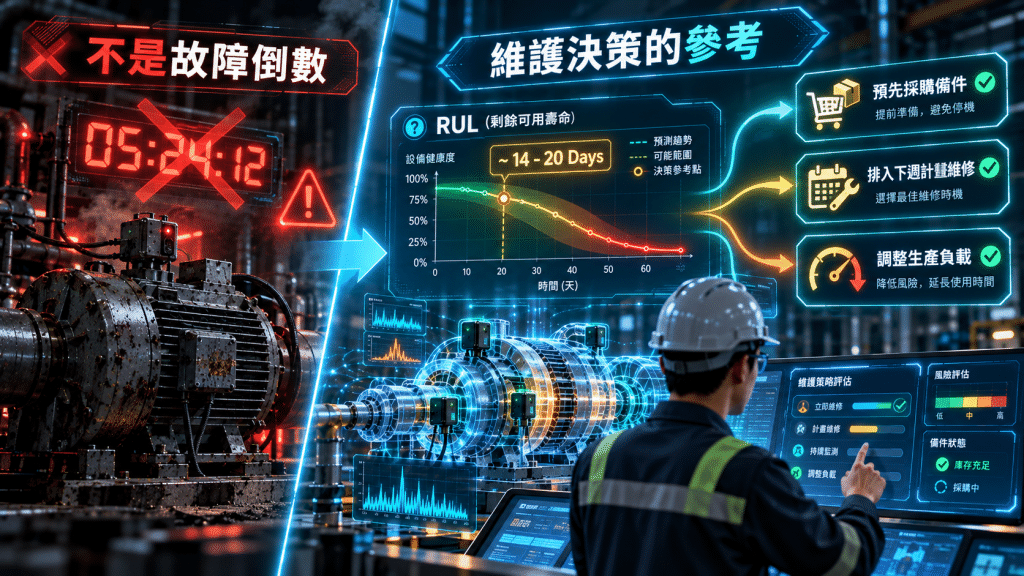
RUL is not a “failure countdown,” but a reference for maintenance decisions.
Suppose the system predicts that a certain device currently has an RUL of approximately 30 days.
This does not mean that the equipment will necessarily fail on the 30th day.
Future load, temperature, lubrication conditions, and operating methods may all change the actual rate of equipment degradation.
Therefore, a more reasonable way to understand RUL is:
Estimate the remaining useful life based on the currently known equipment status and operating conditions.
In practice, maintenance teams should focus more on:
Is the predicted trend stable?
Is the warning time sufficient?
Is the risk increasing rapidly?
Has it entered the window when maintenance should be scheduled?
This is more aligned with the practical needs of industrial maintenance than pursuing “predicting that a failure will definitely occur on a certain day.”
The Value of RUL: From Prediction to Maintenance Decisions
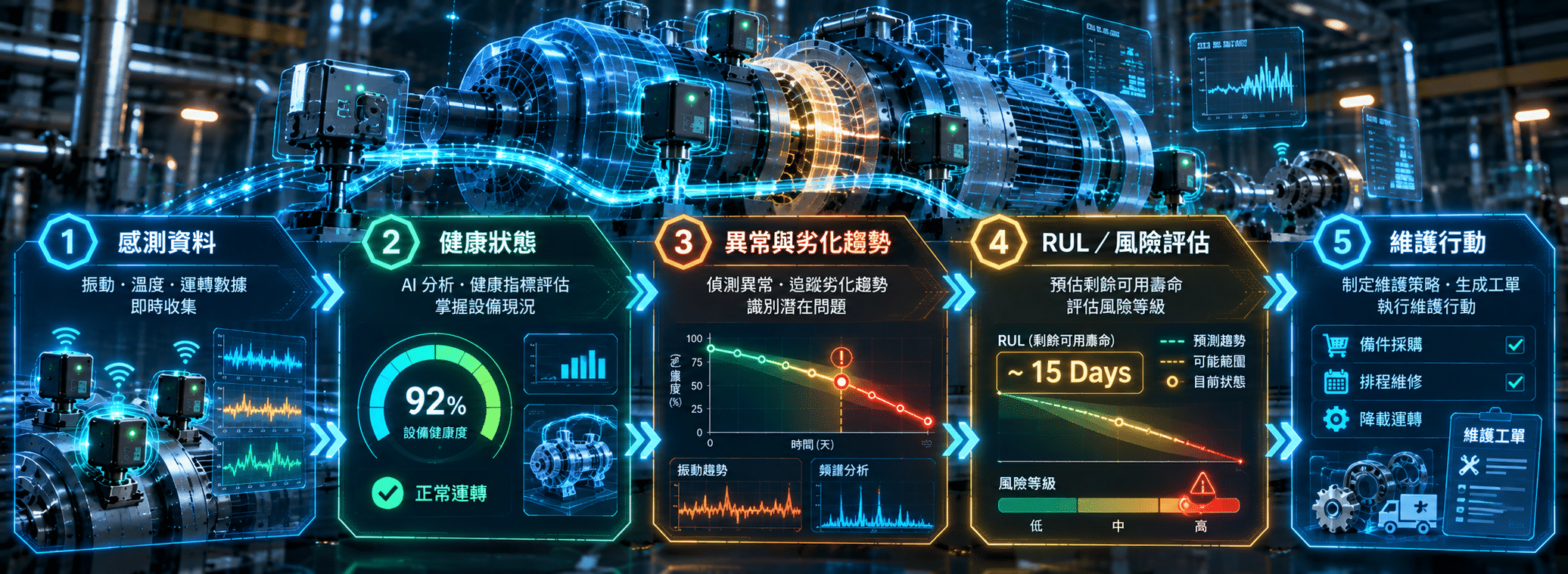
RUL prediction itself is not the end goal; the real value lies in transforming equipment health information into actionable maintenance decisions. The complete process can be understood as:
Sensing Data → Health Status → Anomaly and Degradation Trends → RUL/Risk Assessment → Maintenance Actions。
For example, the optimal shutdown window can be scheduled based on degradation trends, long-lead-time spare parts can be procured in advance, or specialized maintenance personnel can be reserved. At the same time, even equipment with similar RULs may have different maintenance priorities. Therefore, actual decisions should also comprehensively consider RUL, equipment criticality, failure risk, production impact, and maintenance costs, translating prediction results into more economically effective maintenance strategies.
Prognosis: From Vibration Diagnostics to Equipment Health and Degradation Management
For industrial operations, the value of PHM lies not in generating more data, but in:
Can complex equipment signals be transformed into information that maintenance personnel can understand, assess, and act upon.
Prognosis Technology focuses on condition monitoring, vibration diagnostics, and failure prevention for industrial rotating equipment. Through vibration signal analysis, equipment domain knowledge, and AI technology, it helps enterprises monitor equipment health and identify abnormal changes.
A PILOT AI–centered equipment monitoring and diagnostics application that transforms complex vibration signals into easier-to-interpret equipment health information and trends, helping maintenance teams move beyond point alerts to better understand long-term changes in equipment condition.
In RUL applications, the key is not simply to generate a “remaining number of days,” but to establish a complete analytical chain:
Vibration Data → Condition Identification → Anomaly Diagnosis → Health Indicator → Degradation Trend → RUL Assessment → Maintenance Decision
Through this approach, enterprises can gradually move from:
“Deal with it when the equipment breaks”
Direction:
“Once equipment starts to deteriorate, get ahead of the risks.”
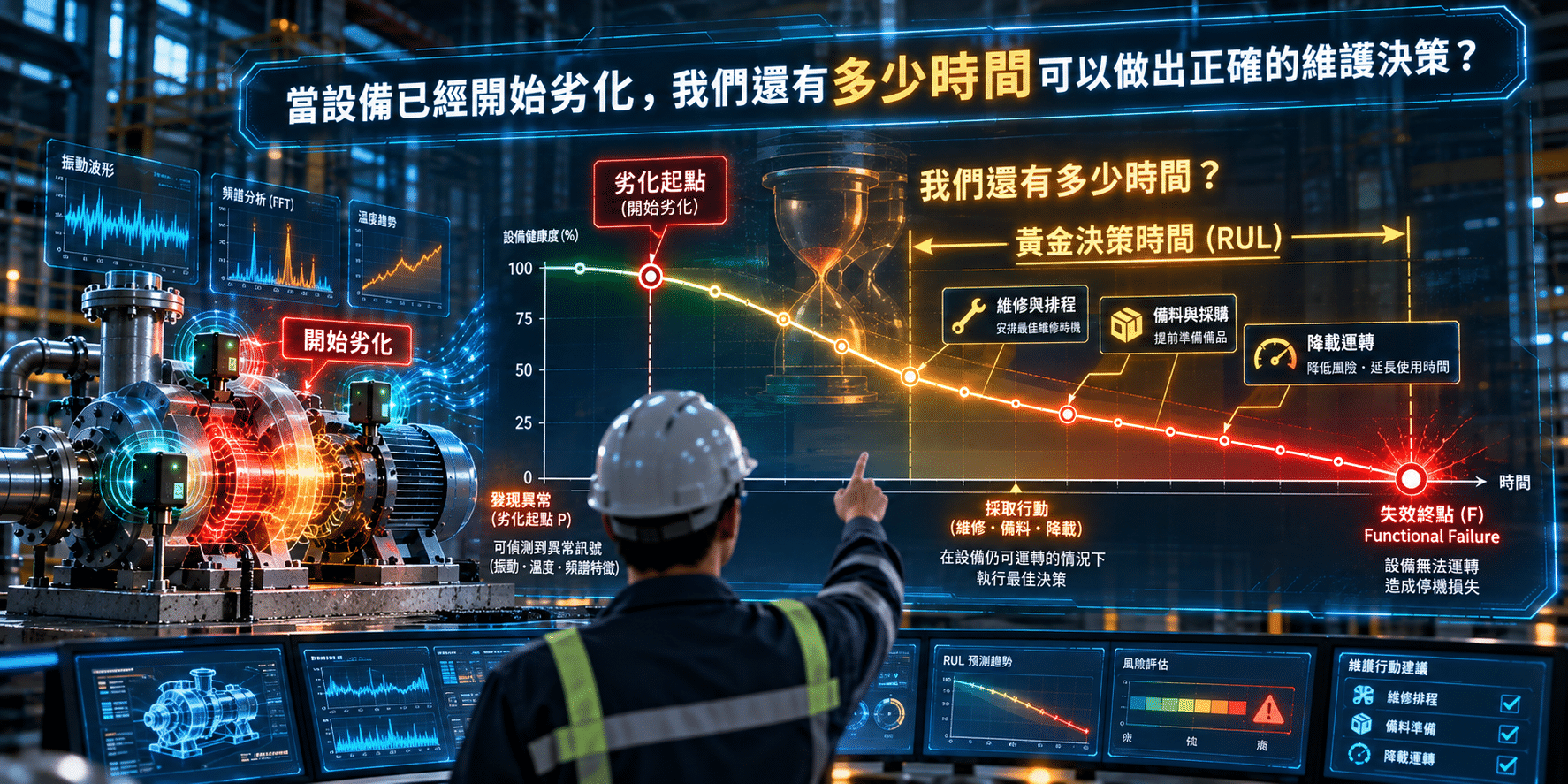
The value of RUL is giving enterprises time to make better maintenance decisions
RUL is not a magic number used to predict the exact date when equipment will fail.
What it truly solves is a very practical industrial problem:
Once the equipment has already begun to deteriorate, how much time do we have left to make the right maintenance decision?
A good RUL system does more than just provide a number of remaining days; it helps enterprises understand the equipment’s current health status, degradation trajectory, and future risks.
When this information can be further linked to production scheduling, spare parts procurement, maintenance manpower, and equipment criticality, equipment maintenance can gradually shift from passive failure handling to proactive maintenance based on condition and risk.
Truly valuable predictions are not about telling you exactly when equipment will fail, but about giving you enough information and time to make better decisions before the equipment actually breaks down.