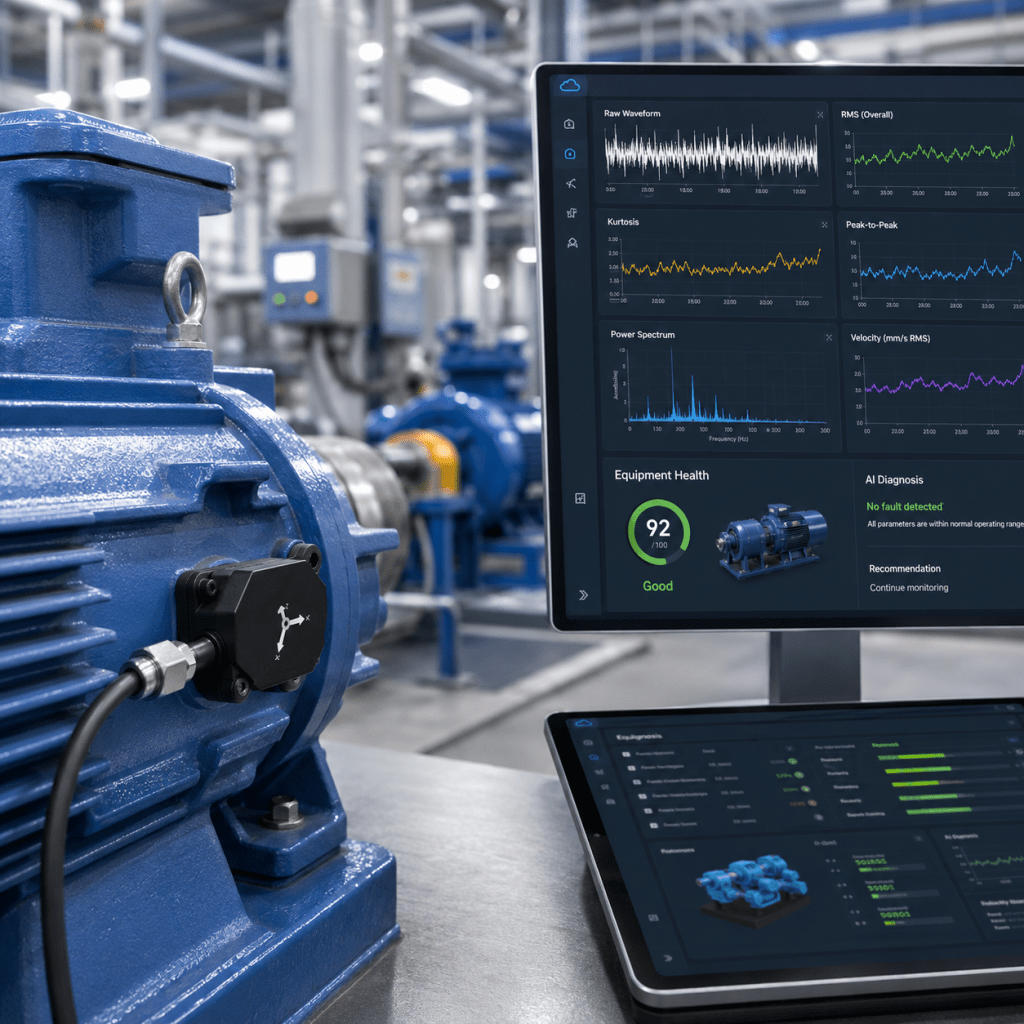
How to Choose the Right MEMS Vibration Sensor?
In industrial condition monitoring and Predictive Maintenance (PdM), vibration sensors serve as the essential first link for acquiring asset health data.
However, when selecting a MEMS vibration sensor, higher specs do not necessarily mean better results. An asset's operating speed, vibration amplitude, target failure modes, and deployment environment all dictate the ideal sensor specifications.
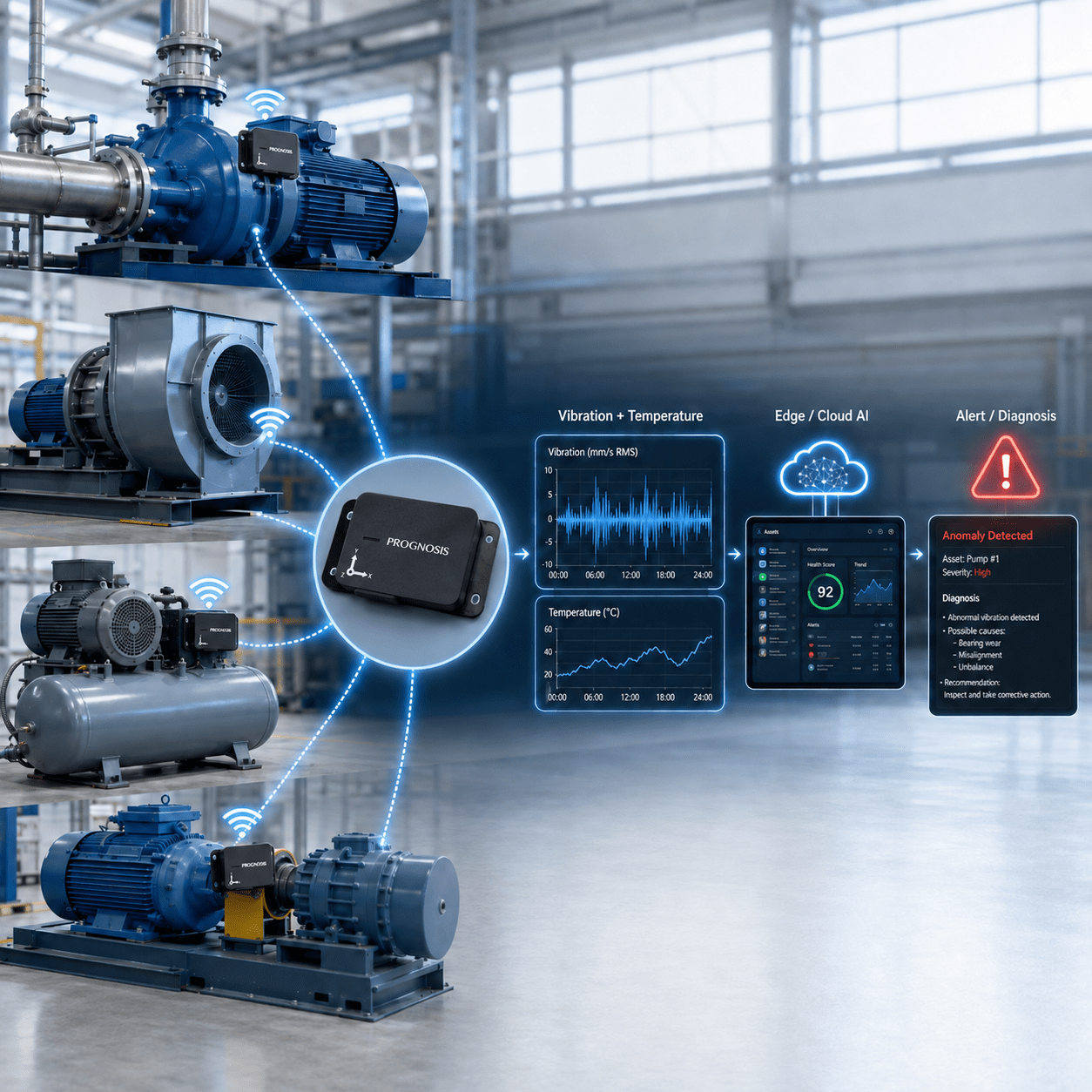
Why Industrial Monitoring Is Transitioning to MEMS Sensors?
With the evolution of Smart Manufacturing and the Industrial Internet of Things (IIoT), asset monitoring is shifting from periodic manual walkthroughs to continuous, automated data collection.
For facilities operating fleets of motors, pumps, fans, air compressors, and rotating machinery, relying on manual measurements is labor-intensive and fails to provide real-time visibility into health degradation.
Modern industrial monitoring prioritizes sensor miniaturization, low power consumption, system integration, and cost-effective fleet-wide deployment.
MEMS (Micro-Electro-Mechanical Systems) technology satisfies these exact needs, making it uniquely suited for continuous, long-term, and high-density asset health monitoring.
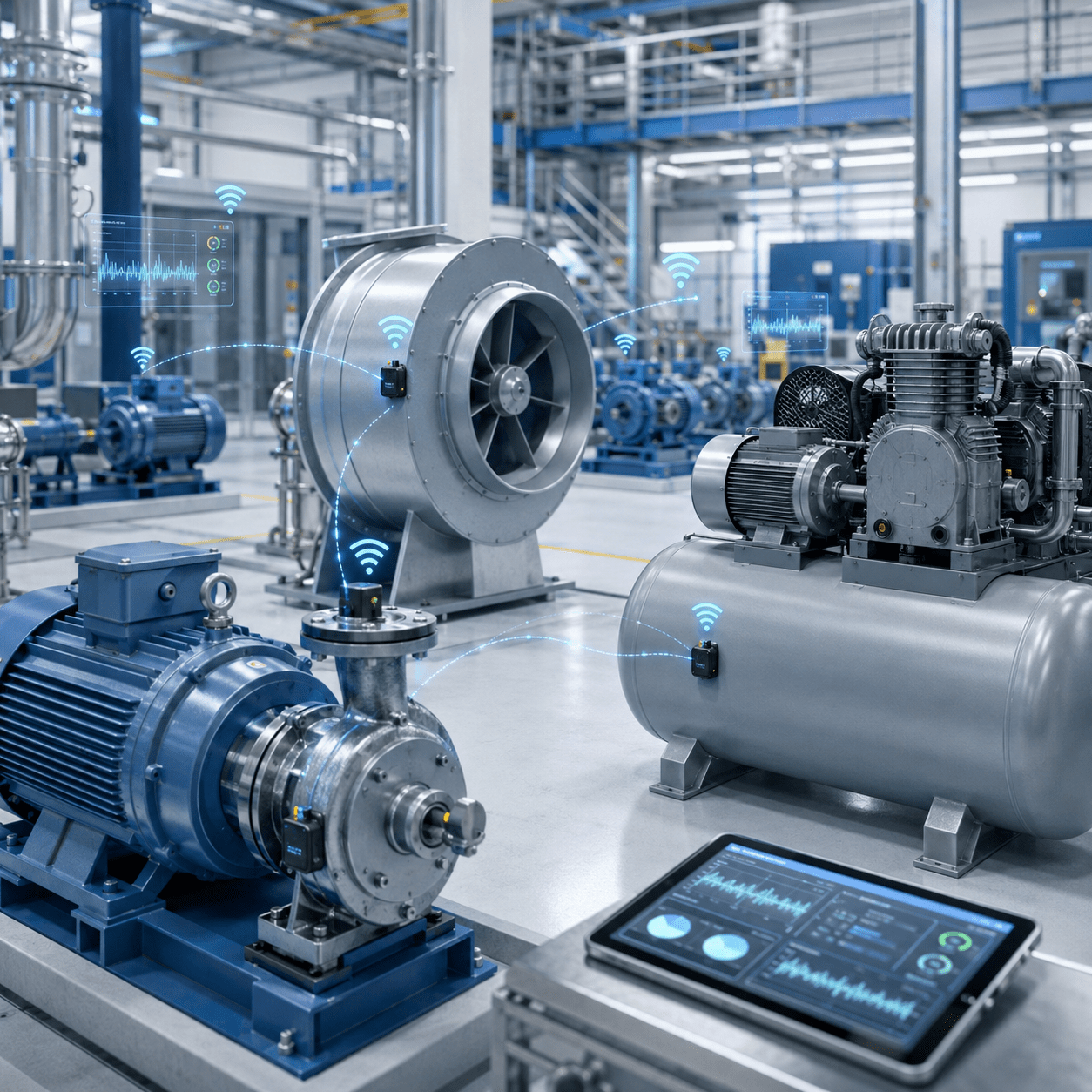
What Is a MEMS Vibration Sensor?
MEMS technology integrates micro-mechanical structures and microelectronic circuits onto a single silicon chip.
In vibration sensing, MEMS devices detect physical acceleration caused by machine motion via micro-machined deflections, converting mechanical movement into precise electrical signals.
Because MEMS architectures integrate onboard signal conditioning, ADCs, MCUs, and digital communication protocols, they can output digital raw data, time-domain features, or frequency spectra tailored directly to downstream system requirements.
Ideal Industrial Applications for MEMS Vibration Sensors
MEMS sensors excel in scenarios requiring continuous monitoring, large-scale deployment, and seamless data integration
Key Application Scenarios:
-
- Motors & Industrial Fans
- Pumps & Compressors
- Chillers & Air Compressors
- Gearboxes & Reducers
- Plant-Wide Fleet Monitoring
- Wireless Telemetry Networks
- AI-Driven PdM Infrastructure
If an enterprise aims to evolve from single-point measurements to a fully integrated asset health monitoring system, sensors must do more than simply 'capture data.' They must also be evaluated against data formats, communication protocols, power consumption, and back-end analytics requirements.

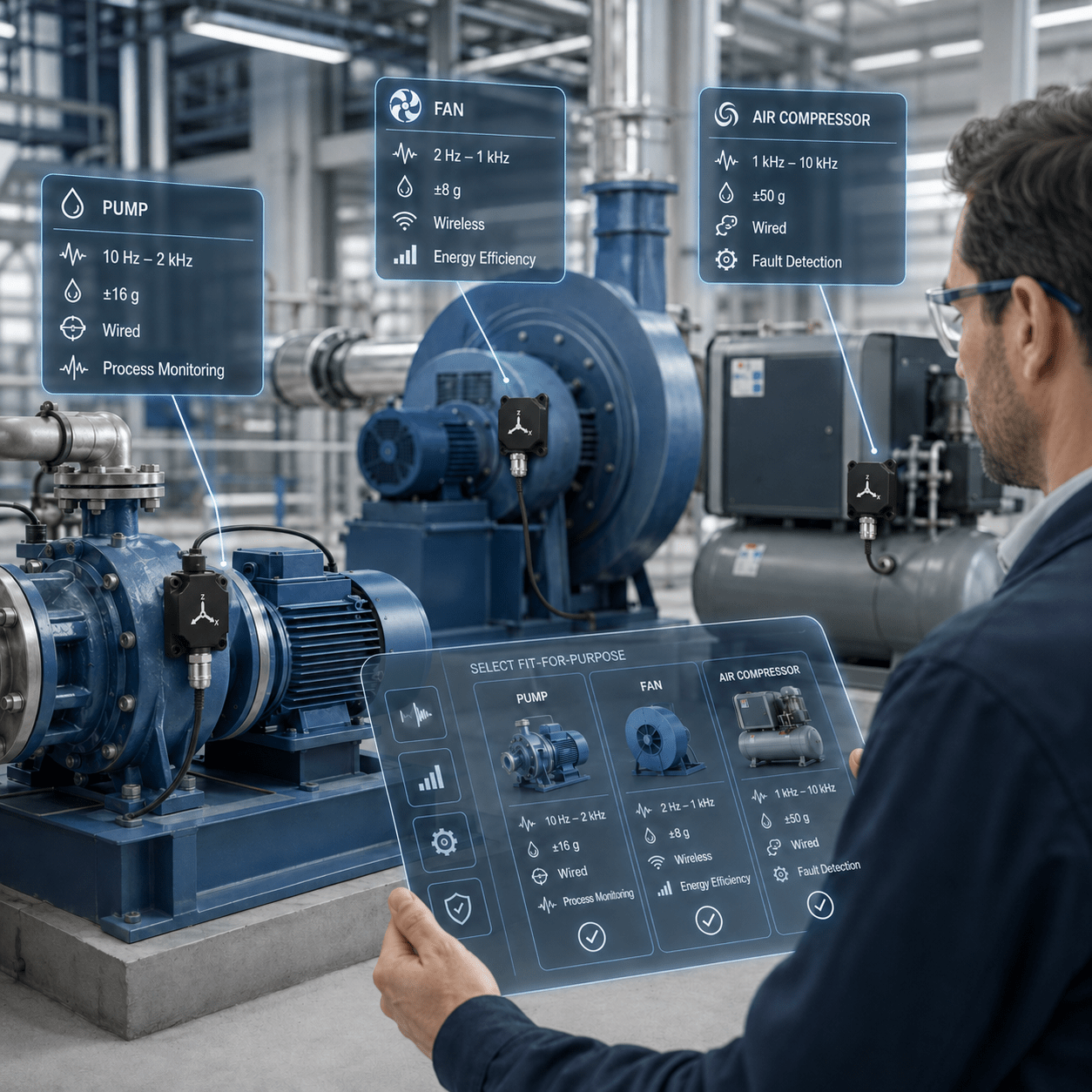
When selecting MEMS vibration sensors, higher specifications do not necessarily mean better performance
The key is matching sensor capabilities to equipment characteristics and diagnostic objectives. Sensor selection requires a holistic evaluation of machine type, operational status, monitoring goals, and the installation environment.
Different assets—such as motors, pumps, fans, and gearboxes—exhibit distinct vibration dynamics across operating speeds, vibration amplitudes, and fault signatures. Therefore, we recommend defining your actual machinery and monitoring requirements first to determine the optimal sensor specifications.
Key Selection Criteria for MEMS Vibration Sensors
Measurement Bandwidth
Target failure modes occur across different frequency ranges.
Analyzing high-frequency anomalies—such as early bearing defect frequencies or gear meshing—demands a wider sensor bandwidth.
Match the bandwidth to your asset speed and target failure signatures.
.Measurement / Dynamic Range
Expressed in ±g, dynamic range defines the maximum acceleration the sensor can measure before signal saturation.
Select a range that accommodates normal operational vibration while leaving headroom for anomaly spikes.
A range that is too small causes signal clipping; an excessively large range reduces measurement resolution.
.Single-Axis vs. Tri-Axial
Tri-Axial Sensors: If you need to track vibration dynamics across multiple spatial directions (X, Y, and Z) simultaneously, tri-axial sensors deliver a comprehensive 3D machine health profile.
Single-Axis Sensors: If the primary vibration vector of concern is already well-defined, a single-axis sensor provides a targeted solution tailored to specific monitoring needs.
Determining whether a single-axis or tri-axial sensor is best suited for your asset depends on the machine's mechanical structure, target fault modes, and physical mounting locations.
.Sampling Rate & Data Processing Output
Higher sampling rates yield detailed frequency spectra for AI diagnostics,
transmission bandwidth, power draw, and storage requirements.
Evaluate your downstream processing architecture (Edge vs. Cloud) to select an optimal sampling configuration.
.Operating Environment & Communication Architecture
Industrial environments demand rugged hardware. Consider:
Environmental Hazards: Outdoor exposure, high humidity, extreme temperatures, or explosive environments requiring explosion-proof (Ex) certification.
Protocol Integration: Ensure compatibility with site infrastructure (wired RS-485/Modbus, Ethernet, or wireless IIoT protocols).
Therefore, when selecting a vibration sensor, we recommend evaluating measurement requirements alongside site environmental conditions and overall system architecture.
From MEMS Sensing to AI Predictive Maintenance
Sensors represent the entry point of the asset health stack.
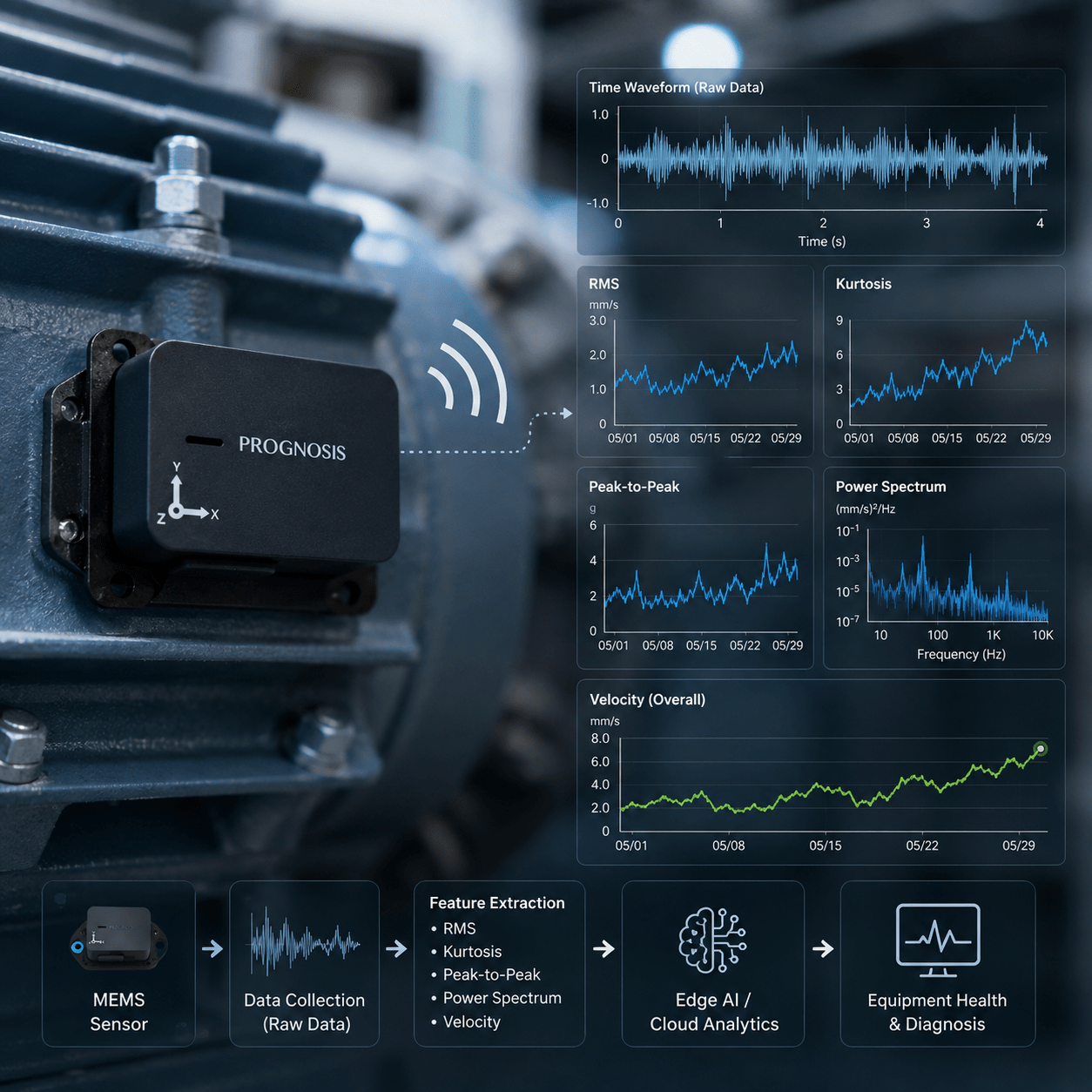
True predictive maintenance relies on transforming raw acceleration signals into actionable operational intelligence.
By analyzing features such as Raw Waveforms, RMS, Kurtosis, Peak-to-Peak, Power Spectra, and Vibration Velocity, maintenance teams gain clear visibility into machine health trends. Prognosis MEMS Sensors support multi-format data outputs—supplying clean, structured data directly to Edge AI modules, cloud platforms, and enterprise asset management systems.
When choosing a MEMS vibration sensor, evaluate not only the hardware specifications, but also how seamlessly the sensor integrates with your overall Edge-to-AI diagnostic architecture.